

The sorghum stalk can be used as sustainable building material. It has high tensile strength of up to 280 Mpa at the middle region, high LEED rating on environmental friendliness, low embodied energy, this will eliminate the underutilization due to traditional usage, stalk is generally left to decompose, or burnt, despite high annual production of sorghum. It can be produced in all semi-arid and tropic areas of the world notably Sub- Saharan African regions. Africa produce 20 million out of 60 million metric tons world annual sorghum production. There is need to make use of sorghum stalk as traditional building material in formwork construction. This research appraises the use of sorghum stalk as soffit in suspended slab as possible alternative to timber planks or plywood in construction. The research adopted quantitative research approach involving experimental and comparative analysis. This research shows the advantages of sorghum stalk to include; availability, affordability, reusability and biodegradability, renewable with little environmental impact among others. The sorghum stalk should be adopted for use as soffit in suspended slab formwork in building construction. This research would contribute to the body of knowledge in the area of sustainable building materials. It is recommended that there should be improvement on the method of usage
Systematic Review of Major Carbon Emissions Trading Systems Worldwide
Track 4: Sustainable Innovations in the Built Environment Ecosystem in Africa Augustine Senanu Komla Kukah
Perception of Ghanaian Construction Employers’ Safety Awareness
Track 4: Sustainable Innovations in the Built Environment Ecosystem in Africa Samuel Kotey
Impact of Sustainable Buildings on Housing Development in Ghana
Track 4: Sustainable Innovations in the Built Environment Ecosystem in Africa Benjamin Botchway
Identifying the Features of Sustainable Electronic Procurement Beneficial to Sustainable Construction Project Delivery
Track 4: Sustainable Innovations in the Built Environment Ecosystem in Africa Derrick Alfa
Determinants of Environmental, Health and Safety (EHS) in the Construction Industry
Track 4: Sustainable Innovations in the Built Environment Ecosystem in Africa Juliet Owusu-Boadi
Circular Immersive Parametric Design Workflow for Sustainable Construction Materials Development
Track 4: Sustainable Innovations in the Built Environment Ecosystem in Africa Patricia Kio
Challenges of Implementing Construction Automation and Robotics: A Review
Track 4: Sustainable Innovations in the Built Environment Ecosystem in Africa Yubo Li
An Assessment on the Current Practices for the Sustainable Construction of Road Infrastructure Projects
Track 4: Sustainable Innovations in the Built Environment Ecosystem in Africa Thabi Mndawe
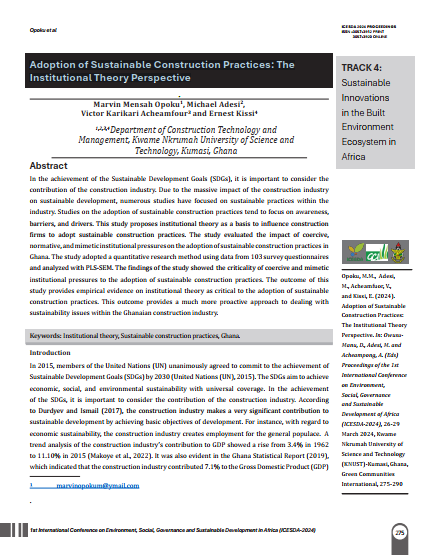
Adoption of Sustainable Construction Practices: The Institutional Theory Perspective
Track 4: Sustainable Innovations in the Built Environment Ecosystem in Africa Marvin Mensah Opoku 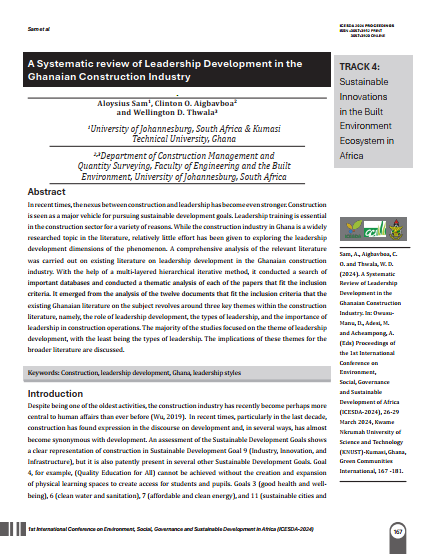 A Systematic review of Leadership Development in the Ghanaian Construction Industry
Track 4: Sustainable Innovations in the Built Environment Ecosystem in Africa Aloysius Sam
A Systematic review of Leadership Development in the Ghanaian Construction Industry
Track 4: Sustainable Innovations in the Built Environment Ecosystem in Africa Aloysius Sam No Books Available!