

The development and progress of a country heavily relies on the construction industry, which creates the necessary infrastructure to support all other sectors. This is demonstrated by the significant number of resources that are invested in the construction industry each year. Procurement activities play a key role in managing construction projects, from the planning stage to the execution and closure. However, traditional paper-based procurement practices are still prevalent in Ghana, resulting in numerous challenges. In light of these challenges, a study was conducted to investigate the factors that influence the adoption of sustainable electronic procurement solutions and their contribution to sustainable project delivery. To achieve this objective, the study employed a quantitative research methodology and purposive sampling to obtain data from 40 out of 70 contractors and consultants in Accra using questionnaires. Cronbach’s Alpha was utilized to evaluate the consistency and dependability of the Likert Scale which was deemed reliable. Kendall’s Coefficient of Concordance was applied to measure the level of agreement among the participants in their rankings, but the outcome indicated a lack of consensus among respondents. The rankings were sorted using RII to identify the most important benefits and the top three benefits are High efficiency, Cost savings in procurement process and Reduction in order fulfilment cycle time. This study contributes to the expanding understanding of electronic procurement and its relationship to sustainable construction, filling a gap in the literature. The outcomes of the research will inspire further investigation in this field.
Systematic Review of Major Carbon Emissions Trading Systems Worldwide
Track 4: Sustainable Innovations in the Built Environment Ecosystem in Africa Augustine Senanu Komla Kukah
Perception of Ghanaian Construction Employers’ Safety Awareness
Track 4: Sustainable Innovations in the Built Environment Ecosystem in Africa Samuel Kotey
Impact of Sustainable Buildings on Housing Development in Ghana
Track 4: Sustainable Innovations in the Built Environment Ecosystem in Africa Benjamin Botchway
Determinants of Environmental, Health and Safety (EHS) in the Construction Industry
Track 4: Sustainable Innovations in the Built Environment Ecosystem in Africa Juliet Owusu-Boadi
Circular Immersive Parametric Design Workflow for Sustainable Construction Materials Development
Track 4: Sustainable Innovations in the Built Environment Ecosystem in Africa Patricia Kio
Challenges of Implementing Construction Automation and Robotics: A Review
Track 4: Sustainable Innovations in the Built Environment Ecosystem in Africa Yubo Li
Appraising the Use of Sorghum Stalk as Soffit Formwork for a Suspended Concrete Slab Construction in Semi-Arid and Tropic Regions
Track 4: Sustainable Innovations in the Built Environment Ecosystem in Africa Mansur Yusuf Illo
An Assessment on the Current Practices for the Sustainable Construction of Road Infrastructure Projects
Track 4: Sustainable Innovations in the Built Environment Ecosystem in Africa Thabi Mndawe
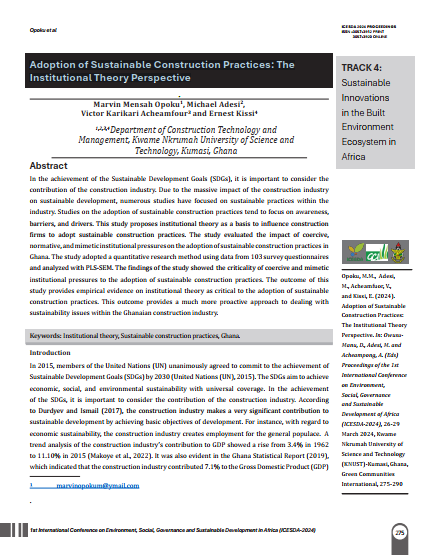
Adoption of Sustainable Construction Practices: The Institutional Theory Perspective
Track 4: Sustainable Innovations in the Built Environment Ecosystem in Africa Marvin Mensah Opoku 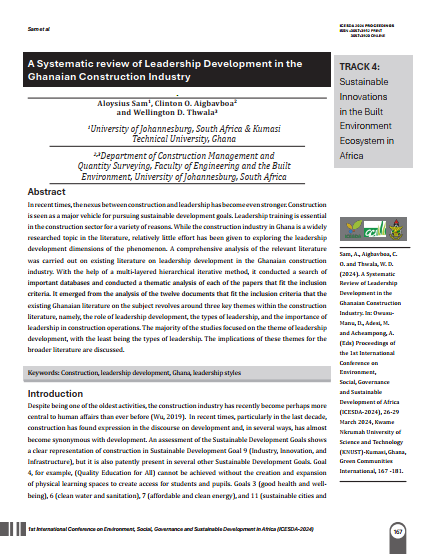 A Systematic review of Leadership Development in the Ghanaian Construction Industry
Track 4: Sustainable Innovations in the Built Environment Ecosystem in Africa Aloysius Sam
A Systematic review of Leadership Development in the Ghanaian Construction Industry
Track 4: Sustainable Innovations in the Built Environment Ecosystem in Africa Aloysius Sam No Books Available!