

Despite the societal and economic significance, the construction industry is notably recognised as a global contributor to occupational injuries. Environmental, health and safety (EHS) has become a fundamental and strategic element for business operations of industries. Yet, the construction industry continually faces challenges regarding EHS practices. Managing and implementing effective EHS strategies enables organisations to achieve their business objectives and increase productivity. While the field of occupational health and safety (OHS) has gained significant traction in the industry, there has been a lack of focus on effectively managing the environmental, safety, and health implications on the construction workforce and its activities. This study aims to determine the EHS components in the construction industry. A comprehensive literature review was conducted using Scopus and Google Scholar databases. The study findings identified components of each aspect. Environmental factors include waste management, noise, air emissions and ambient air quality, water management, energy conservation, and land management. Major health factors identified include physical, psychological, biological, chemical, ergonomics and psychosocial factors. In contrast, major safety components identified include safety climate, safety perceptions, safety behaviours, management strategies and physically unsafe conditions. The study outcome will enhance the study of critical factors influencing EHS on construction sites in future research.
Systematic Review of Major Carbon Emissions Trading Systems Worldwide
Track 4: Sustainable Innovations in the Built Environment Ecosystem in Africa Augustine Senanu Komla Kukah
Perception of Ghanaian Construction Employers’ Safety Awareness
Track 4: Sustainable Innovations in the Built Environment Ecosystem in Africa Samuel Kotey
Impact of Sustainable Buildings on Housing Development in Ghana
Track 4: Sustainable Innovations in the Built Environment Ecosystem in Africa Benjamin Botchway
Identifying the Features of Sustainable Electronic Procurement Beneficial to Sustainable Construction Project Delivery
Track 4: Sustainable Innovations in the Built Environment Ecosystem in Africa Derrick Alfa
Circular Immersive Parametric Design Workflow for Sustainable Construction Materials Development
Track 4: Sustainable Innovations in the Built Environment Ecosystem in Africa Patricia Kio
Challenges of Implementing Construction Automation and Robotics: A Review
Track 4: Sustainable Innovations in the Built Environment Ecosystem in Africa Yubo Li
Appraising the Use of Sorghum Stalk as Soffit Formwork for a Suspended Concrete Slab Construction in Semi-Arid and Tropic Regions
Track 4: Sustainable Innovations in the Built Environment Ecosystem in Africa Mansur Yusuf Illo
An Assessment on the Current Practices for the Sustainable Construction of Road Infrastructure Projects
Track 4: Sustainable Innovations in the Built Environment Ecosystem in Africa Thabi Mndawe
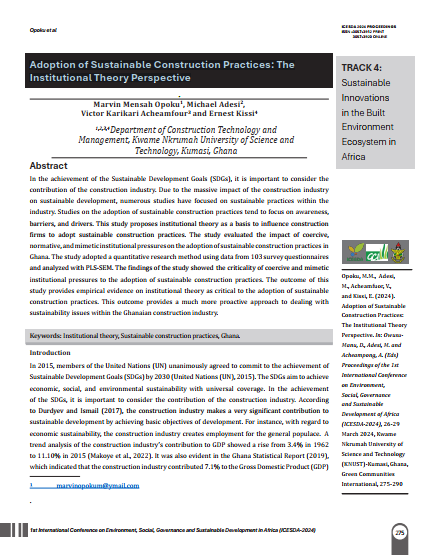
Adoption of Sustainable Construction Practices: The Institutional Theory Perspective
Track 4: Sustainable Innovations in the Built Environment Ecosystem in Africa Marvin Mensah Opoku 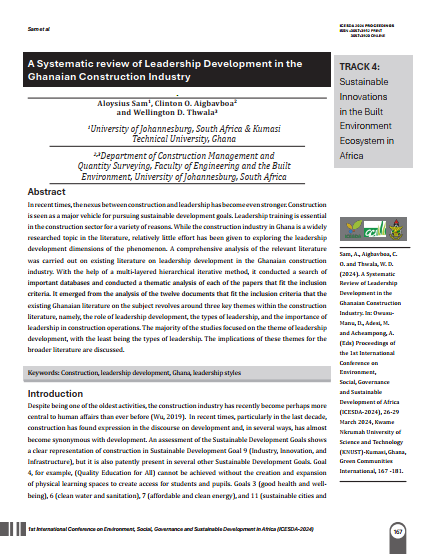 A Systematic review of Leadership Development in the Ghanaian Construction Industry
Track 4: Sustainable Innovations in the Built Environment Ecosystem in Africa Aloysius Sam
A Systematic review of Leadership Development in the Ghanaian Construction Industry
Track 4: Sustainable Innovations in the Built Environment Ecosystem in Africa Aloysius Sam No Books Available!