

To achieve digital transformation in construction, both academics and practitioners have undertaken research into various aspects of digital twin technology applications. Yet despite numerous studies conducted, the ensuing discourse contains limited information regarding the barriers to digital twin adoption specifically during the design phase of construction projects. This study therefore, explores the critical barriers hindering the integration of digital twin technology during the design phase in the Ghanaian construction industry (GCI), establishing the criticality of the principal barriers identified. A postpositivist philosophical design was adopted to deductively analyse primary data collected via a survey questionnaire. A comprehensive literature review was first conducted to identify the barriers to digital twin integration during the construction design phase. Data gathered from construction professionals with knowledge of digital technologies and design processes was then analysed using descriptive statistics, mean score ranking, normalization technique, and exploratory factor analysis. Two principal barriers to digital twin integration during the design phase in the GCI were identified: Technical and Operational Challenges (comprising investment difficulties, real-time data challenges, difficulties in systems integration, data security issues, project complexities, poor data quality, need for constant internet connectivity, lack of methodologies and tools, scalability issues, and standards and governance); and Knowledge and Adoption Barriers (comprising low level of knowledge, difficulties in data integration, low level of technology acceptance, and lack of clear digital twin value propositions). The analysis revealed that low level of knowledge, difficulties in data integration, need for constant internet connectivity, investment difficulties, poor data quality, and lack of methodologies and tools (mean = 3.70) were the most critical barriers. The exploratory factor analysis confirmed two distinct barrier components explaining 68.192% of the total variance. Evidently, digital twin integration during the design phase in the GCI faces major challenges and consequently, sector stakeholders must strategize their organizational undertakings to transition from traditional design practices towards digital twin-enabled approaches. This study provides a novel and thorough evaluation of barriers to digital twin integration specifically during the design phase and establishes the criticality of the identified barriers within a developing economy context. The study’s findings offer essential direction to GCI stakeholders and policymakers to facilitate digital transformation in construction design processes in accordance with global digitalization initiatives and Industry 4.0 implementation goals
Harnessing traditional knowledge and cultural values for environmental protection: a socio-ecological framework for addressing water pollution from illegal mining in Ghana
ICESDA 2025 Maxwell Boateng Asare
The Value of Sustainable Design in Real Estate: A Case Study of the Kwame Nkrumah University of Science and Technology in Ghana
ICESDA 2025 Kenneth Appiah Donkor-Hyiaman
Sustainable Corporate Social Responsibility Practices in the Ghanaian Construction Sector: An Observational Study
ICESDA 2025 Frank Amoah
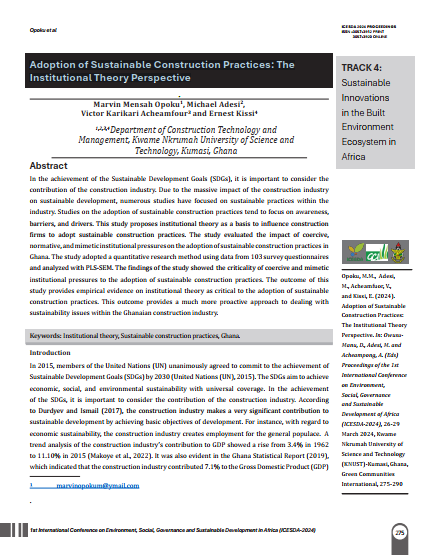
Sustainable Construction Practices in Tarkwa, Ghana: Adoption, Challenges, and Stakeholder Perspectives
ICESDA 2025 Carin Awoenam Fianu
Subsidy Reform at the Crossroads: Ghana’s Artisanal Fisheries, WTO Commitments, and the Future of Coastal Livelihoods
ICESDA 2025 Shaibu Mustapha
Stakeholder-Driven Tensions in Public Procurement Sustainability: Insights from a Systematic Literature Review in Ghana
ICESDA 2025 Jocilyn Kwame Gyelaa
Managing Stakeholders’ Interests Towards the Sustainability of Corporate Social Responsibility (CSR) Projects – A Paradigmatic and Methodological Review
ICESDA 2025 Fynn Emmanuel Mends
Integrating Environmental, Social, and Governance (ESG) and Sustainability in Public and Private Sector Institutions in Africa
ICESDA 2025 Gale B. Frazier
Industry 4.0 technologies as a solution to the negative environmental impacts caused by the construction industry
ICESDA 2025 Sandisiwe Nonqonqoto
Socio-Economic Factors Influencing the Adoption of Sustainable Energy Technologies and Practices In Ghana
Track 5: Sustainable Innovations in Urban Configuration and Mobility in Africa Africa Samuel Gyimah  ICESDA 2025 Full Proceedings