

Sustainable urban development in Sub-Saharan Africa faces severe challenges from rapid urbanization and evolving mobility needs. Defined as non-motorized, low-carbon, and shared transport systems, eco-mobility offers a pathway towards inclusive, resilient, and sustainable cities. The study presents a systematic scoping review and bibliometric analysis of 118 peer-reviewed publications from the Scopus database, dated from 2015 to 2023, to examine the relationship between eco-mobility and urban morphology. By using Biblioshiny and VOSviewer, the review mapped evolving keywords, key authors, and influential publications. Additionally, six main thematic clusters were identified, including smart technologies for sustainable communities, sociodemographic mobility factors, and policy frameworks for inclusive transport systems. With global interest in eco-mobility, the findings reveal a lack of context-specific research in African cities, particularly in terms of methodological approaches, sociodemographic diversity, and geographic representation. The paper provides a consolidated review of eco-mobility and urban morphology in Sub-Saharan Africa by identifying the global north bias, synthesizing key gaps, and proposing future research and policy agendas that emphasize context-sensitive approaches, spatial equity, low-carbon transitions, and sustainable land-use strategies to guide eco-mobility integration in Sub-Saharan Africa
Harnessing traditional knowledge and cultural values for environmental protection: a socio-ecological framework for addressing water pollution from illegal mining in Ghana
ICESDA 2025 Maxwell Boateng Asare
The Value of Sustainable Design in Real Estate: A Case Study of the Kwame Nkrumah University of Science and Technology in Ghana
ICESDA 2025 Kenneth Appiah Donkor-Hyiaman
Sustainable Corporate Social Responsibility Practices in the Ghanaian Construction Sector: An Observational Study
ICESDA 2025 Frank Amoah
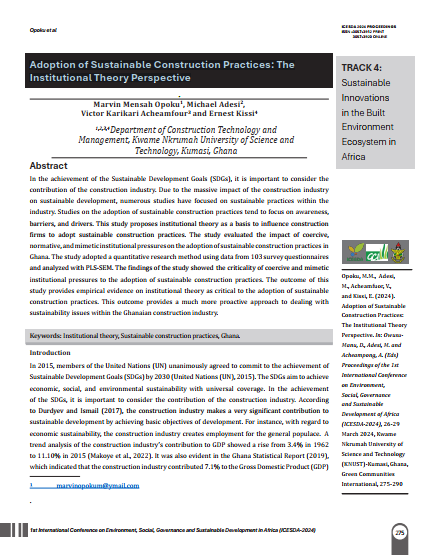
Sustainable Construction Practices in Tarkwa, Ghana: Adoption, Challenges, and Stakeholder Perspectives
ICESDA 2025 Carin Awoenam Fianu
Subsidy Reform at the Crossroads: Ghana’s Artisanal Fisheries, WTO Commitments, and the Future of Coastal Livelihoods
ICESDA 2025 Shaibu Mustapha
Stakeholder-Driven Tensions in Public Procurement Sustainability: Insights from a Systematic Literature Review in Ghana
ICESDA 2025 Jocilyn Kwame Gyelaa
Managing Stakeholders’ Interests Towards the Sustainability of Corporate Social Responsibility (CSR) Projects – A Paradigmatic and Methodological Review
ICESDA 2025 Fynn Emmanuel Mends No Books Available!
 ICESDA 2025 Full Proceedings