

Amidst escalating demands for sustainable urban development and environmental accountability, the Environmental, Social, and Governance (ESG) Value, Intelligence, Sustainability and Accountability (VISA) concept emerges as an innovative, technology-driven response to persistent profound challenges encountered in Hong Kong (HK)’s densely built environment. As informed by the PESTLE analysis, it serves as a strategic blueprint that unites environmental performance with technological and financial viability. The analysis identified six critical domains: increasing government Environmental, Social, Governance (ESG) mandates (Political), cost pressure for green retrofits (Economic), public demand for equitable, accessible spaces (Social), proliferation of smart technologies (Technological), tightening regulatory expectations (Legal), and climate vulnerability of high-density buildings (Environmental). Inspired by the functionality of digital passports, ESG VISA incorporates financial dimensions and time-bound validity to create a dynamic compliance instrument. It integrates six core digital technologies, including Artificial Intelligence (AI), Blockchain, Building Information Modelling (BIM), and the Internet of Things (IoT), supported by Cloud Computing and Big Data, and establishes digital identities and real-time performance tracking into a unified ESG governance framework. This approach enables buildings to move beyond passive compliance toward active participation in sustainability development goals. Unlike conventional ESG reporting, it operationalizes ESG as a strategic, lifecycle-oriented tool. The uniqueness of the proposed ESG VISA lies in transforming fragmented data and siloed systems into a transparent, interoperable ESG architecture that enhances stakeholder trust and enables dynamic performance benchmarking. While ESG VISA was conceived in the context of HK’s complex regulatory and infrastructural landscape, its core principles offer a transferable, innovative and integrated solution to emerging economies such as Ghana facing similar urban and environmental pressures. The significance of ESG VISA rests in its potential to redefine ESG implementation—not as static documentation, but as a dynamic system for sustainable transformation in the built environment.
Harnessing traditional knowledge and cultural values for environmental protection: a socio-ecological framework for addressing water pollution from illegal mining in Ghana
ICESDA 2025 Maxwell Boateng Asare
The Value of Sustainable Design in Real Estate: A Case Study of the Kwame Nkrumah University of Science and Technology in Ghana
ICESDA 2025 Kenneth Appiah Donkor-Hyiaman
Sustainable Corporate Social Responsibility Practices in the Ghanaian Construction Sector: An Observational Study
ICESDA 2025 Frank Amoah
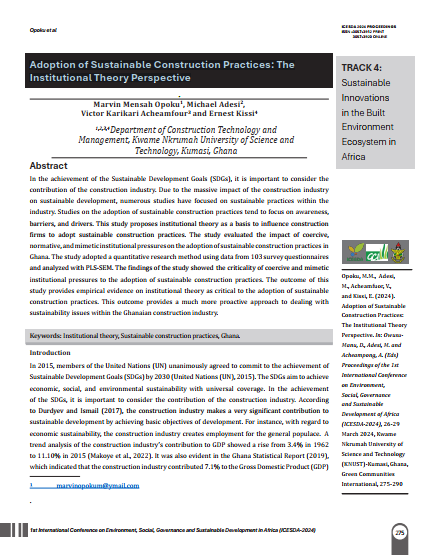
Sustainable Construction Practices in Tarkwa, Ghana: Adoption, Challenges, and Stakeholder Perspectives
ICESDA 2025 Carin Awoenam Fianu
Subsidy Reform at the Crossroads: Ghana’s Artisanal Fisheries, WTO Commitments, and the Future of Coastal Livelihoods
ICESDA 2025 Shaibu Mustapha
Stakeholder-Driven Tensions in Public Procurement Sustainability: Insights from a Systematic Literature Review in Ghana
ICESDA 2025 Jocilyn Kwame Gyelaa
Managing Stakeholders’ Interests Towards the Sustainability of Corporate Social Responsibility (CSR) Projects – A Paradigmatic and Methodological Review
ICESDA 2025 Fynn Emmanuel Mends No Books Available!
 ICESDA 2025 Full Proceedings